Sodium thioglycolate (CAS 367-51-1), a commonly used chemical in the chemical industry and daily life sectors, has its potential hazards following human exposure and the corresponding protective technologies as the core issues for safeguarding occupational health and public safety. Based on the exposure standards of the U.S. Occupational Safety and Health Administration (OSHA) and the research data of the National Institute for Occupational Safety and Health (NIOSH), this paper systematically analyzes the hazards of different exposure routes to the human body and provides feasible protective technical solutions, integrating scientific rigor and practical operability.
1.Sodium thioglycolate Overview of Environmental Impact
Sodium Thioglycolate is widely used in chemical synthesis, laboratory reagents, and personal care manufacturing. However, its lifecycle—from production to disposal—presents significant ecological risks if not managed through rigorous safety protocols. Due to its chemical stability, this compound has a natural half-life of 14 to 21 days in aquatic environments, making it resistant to rapid biodegradation and prone to accumulation in sediment.
2.Ecological Toxicity Data (EPA & ISO Standards)
According to data aligned with U.S. EPA Ecotoxicology standards and ISO 10993 assessment methods, Sodium Thioglycolate exhibits specific toxicity levels across different ecosystems:
A. Aquatic Ecosystems
The compound is highly hazardous to aquatic life even at low concentrations:
Freshwater Fish (e.g., Zebrafish): Concentrations ≥0.5 mg/L cause gill damage and respiratory distress. The 96-hour Median Lethal Concentration (LC50) is documented at 2.3 mg/L.
Aquatic Plants (e.g., Duckweed): The EC50
(Half Maximal Effective Concentration) for growth inhibition is 1.8 mg/L, which can disrupt the entire aquatic food chain over long-term exposure.
B. Soil and Agriculture
In soil, Sodium Thioglycolate binds with metal ions to form insoluble compounds, reducing soil permeability and hindering root development:
Crop Impact: Soil concentrations exceeding 5 mg/kg reduce the germination rates of staples like wheat and corn by more than 20%.
Bioaccumulation: There is a persistent risk of the compound entering the human food chain through agricultural accumulation.
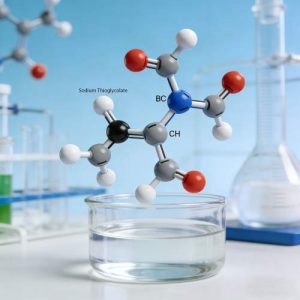
3.Comprehensive Ecological Safety Controls
To mitigate these risks, a “Three-Pillar” management strategy is recommended:
Source Reduction: Implement closed-loop manufacturing processes to minimize wastewater volume.
Process Containment: Equip storage areas with leak-proof secondary containment pallets to prevent soil infiltration during accidental spills.
End-of-Pipe Treatment: * Wastewater must undergo neutralization and oxidation until Sodium Thioglycolate levels fall below 0.1 mg/L before discharge.
Waste disposal must follow EPA Hazardous Waste classifications, utilizing certified facilities for high-temperature degradation (requiring a degradation efficiency of ≥99%).
4.Regulatory Compliance and Global Trade
For businesses operating internationally, compliance is not universal:
EU REACH Regulation: European standards for Sodium Thioglycolate discharge are often more stringent than other regions.
Compliance Strategy: Exporters must conduct proactive ecotoxicological testing to meet target market regulations and avoid legal or logistical bottlenecks.